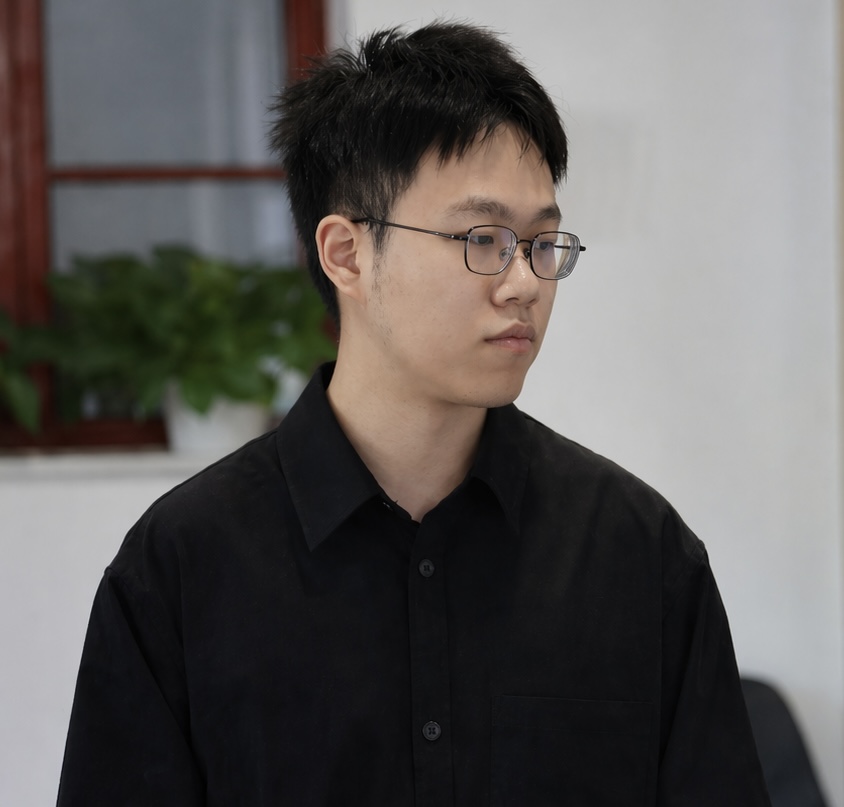
Welcome to Yichuan Mo’s Homepage! 👏
I am a fourth-year PhD candidate at the ZERO Lab in the School of Intelligence Science and Technology at Peking University, advised by Prof. Yisen Wang. I received my bachelor's degree from Shanghai Jiao Tong University in 2022, where I was co-advised by Prof. Shilin Wang and Prof. Junchi Yan.
My research focuses on the safety alignment of deep learning models, particularly Large Language Models and diffusion-based image/text generation models with over 1k citations. More broadly, I am interested in exploring next-generation language model paradigms, including model architectures, post-training, and decoding strategies. Recently, I have been studying language diffusion models and investigating their potential integration with conventional auto-regressive pipelines.
I am an optimistic and kind person who enjoys finding happiness in everyday life. I am particularly passionate about sports, especially badminton, swimming, and running. My long-term aspiration is to build safe Artificial General Intelligence (AGI) systems that can continuously and reliably benefit all humanity. In the face of rapidly evolving AI technologies, I maintain a humble attitude and learn from fellow researchers and enjoy embracing new challenges.
I expect to graduate in June 2027 and am currently seeking job opportunities starting in summer 2027 in areas including large language model training, quant research, and academic positions. Feel free to contact me at mo666666@stu.pku.edu.cn!
🎓 Education
 Peking UniversitySep. 2022 – PresentPh.D. CandidateSchool of Intelligence Science and Technology
 Shanghai Jiao Tong UniversitySep. 2018 – Jun. 2022B.Eng.School of Computer Science
💯 Academic Performance
Undergraduate
- GPA: 90.93/100 (or 3.94/4.3), Rank: 2/128 (Top 1.6%)
- Courses: 55.81% above A, 24.42% above A+
Graduate
- GPA: 3.88/4.0
- Courses: 71.4% above A
🏆 Selective Awards
Undergraduate
- 2019.10 Merit Student of Shanghai Jiao Tong University
- 2019.12 National Scholarship (Top 1% in CE Dept.)
- 2020.12 National Scholarship (Top 1% in CE Dept.)
- 2021.12 Weichai Power Scholarship
- 2022.05 Outstanding Dormitory
- 2022.06 Outstanding Graduate of Shanghai (Top 3%)
- 2022.06 Outstanding Undergraduate Thesis, Shanghai Jiao Tong University (Top 1%, 1 out of 128 students in CE Dept.)
Graduate
- 2022.12 Sunshine Dormitory
- 2023.09 Xiaomi Scholarship (First-Class)
- 2023.09 Merit Student of Peking University
- 2024.09 Yuehua Luo Scholarship
- 2024.09 Outstanding Research Award in Peking University
- 2025.04 Nomination for Academic Star(Five Graduate students in AI Dept.)
- 2025.11 Taotian Scholarship (Eight Graduate students in AI Dept.)
- 2026.04 Optiver AI PhD Scholarship (Six PhD students in China)
📝 Papers
(* Equal Contribution and # Student First Author)
Accepted
TrustLDM: Benchmarking Trustworthiness in Language Diffusion Model
ICLR 2026 Trustworthy Workshop (First benchmark for evaluating trustworthiness of language diffusion models)
Decoding Large Language Diffusion Models with Foreseeing Movement
ICLR 2026 DeLTa Workshop
Jailbreak and Guard Aligned Language Models with Only Few In-Context Demonstrations
TPAMI 2026 (Adopted at scale by Anthropic)
On the Adversarial Transferability of Generalized “Skip Connections”
TPAMI 2026 (Journal extension of SGM, original paper cited 400+ times on Google Scholar)
Fight Back Against Jailbreaking via Prompt Adversarial Tuning
NeurIPS 2024
TERD: A Unified Framework for Safeguarding Diffusion Models Against Backdoors
ICML 2024 (First backdoor input detection method for diffusion models)
PID: Prompt-Independent Data Protection Against Latent Diffusion Models
ICML 2024
When Adversarial Training Meets Vision Transformers: Recipes from Training to Architecture
NeurIPS 2022 (Spotlight, Top 5%) (First work to improve adversarial robustness of ViTs)
Improving Generative Adversarial Networks via Adversarial Learning in Latent Space
NeurIPS 2022 (Spotlight, Top 5%)
DICE: Domain-attack Invariant Causal Learning for Improved Data Privacy Protection and Adversarial Robustness
SIGKDD 2022
Multi-Task Learning Improves Synthetic Speech Detection
ICASSP 2022
Preprint
SelfCAD: Protecting Your Efficient Reasoning Capabilities via Self-Cautious Insertion
Preprint 2026
Generalist++: A Meta-learning Framework for Mitigating Trade-off in Adversarial Training
arXiv 2025
Are Smarter LLMs Safer? Exploring Safety-Reasoning Trade-offs in Prompting and Fine-Tuning
arXiv 2025 (First to reveal the safety–reasoning capability trade-off)
🤖 Open-source Models
Baichuan-M3: Modeling Clinical Inquiry for Reliable Medical Decision-Making
World's Top Medical AI Model (Jan. 2026)
Baichuan-M2: Scaling Medical Capability with Large Verifier System
World's Top Open-Source Medical AI Model (Aug. 2025)
🛠️ Academic Service
- Reviewer: NeurIPS 2023/2024/2025; ICLR 2024/2025/2026; ICML 2024/2025/2026; CVPR 2025/2026; ICCV 2025; IJCAI 2024; AAAI 2025/2026; AISTATS 2025; ECCV 2026
- Top Reviewer of NeurIPS 2023 (Top 10.49%)
- Top Reviewer of NeurIPS 2024 (Top 8.60%)
- Top Reviewer of NeurIPS 2025 (Top 8.02%)
- Notable Reviewer of ICLR 2025 (Top 3%)
🔗 Links
(Alphabetical Order)
- My Best Friends: Haoyu Geng, Zetian Jiang, Danning Lao, Yang Li, Chang Liu, Han Lu, Xudong Lu, Qibing Ren, Yuji Wang, Nianzu Yang
- My Best Labmates: Jingyi Cui, Tianqi Du, Lizhe Fang, Xiaojun Guo, Mingjie Li, Ykang Li, Yifei Wang, Zeming Wei, Pengyun Yue, Qi Zhang, Yige Zhang